As a physicist, I think of colours as numbers. Different sets of numbers, even. The wavelength and frequency of the light wave, as well as the energy associated with its other form—the photon or “light particle”. For example, “green” is both 532 nanometres* (wavelength) and 2,3 electron-volts (energy). These are just common values for a green laser that I have encountered repeatedly. *one nanometre (nm) is 0,0000001 cm or 10-7 cm, roughly the length of 10 hydrogen atoms in a row “Green” spans a range of values, but the main thing is that it’s in the 500-something ballpark—it’s not 300 or 1000 nanometres (which would be ultraviolet and infrared).
Importantly, this conversion is an automatic response in me, conditioned over the years, similar to recalling a memorized poem, or rather knowing roughly how warm 20°C feels or how heavy 5 kg feels.
Even if the origin of this knowledge of colour stems from complicated theories of electromagnetism and quantum mechanics, people in the field usually don’t give a second thought about the theory when employing these intuitive shortcuts. It’s just the electromagnetic spectrum, duh.
Physicists take for granted that light, and radio waves, and microwaves, and X-rays, are essentialy the same thing. For many others, this would be a mind-bending revelation. Which is not to imply superiority—my point is exactly that this is a scale that can be learned as any other. We can hear the different sounding notes of do-re-mi, yet they are sound waves all the same. (So light and sound are both waves? Yes! One more revelation that is more profound than it seems.)
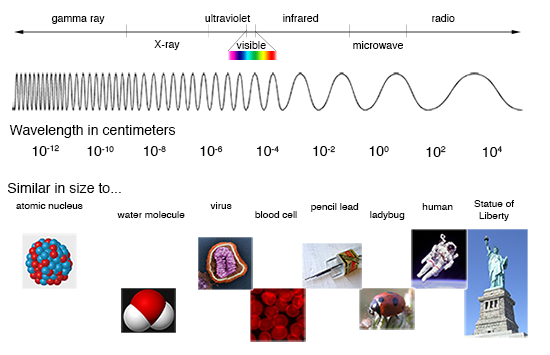
Credit: NASA’s Imagine the Universe
Another group for which colours are numbers is designers (print and digital). They work with colour spaces—basically maps in which colours are represented by coordinates. For example, it can be how much red, green or blue is present in a colour (RGB space). Roughly speaking, this number tells the pixels of your screen how strongly to shine in order to create the specific colour. Same in print—the CMYK model is just another set of colour coordinates which tells the printer how much ink of each primary component to mix.

Left: CMYK-printed photo with apparent light blue/teal colour.
Right: Magnified by microscope, shows a blend of cyan, magenta, yellow and black.
Colours are more than numbers, of course. But they have a hidden numerical skeleton. Exploring it is a cool way to learn some physics.